Rubber plant care means providing bright indirect light, a draining root zone and a stable position. Sudden leaf drop calls for a review of watering and recent changes before adding products. This guide covers Ficus elastica, including variegated forms, rather than fiddle-leaf figs or weeping figs.
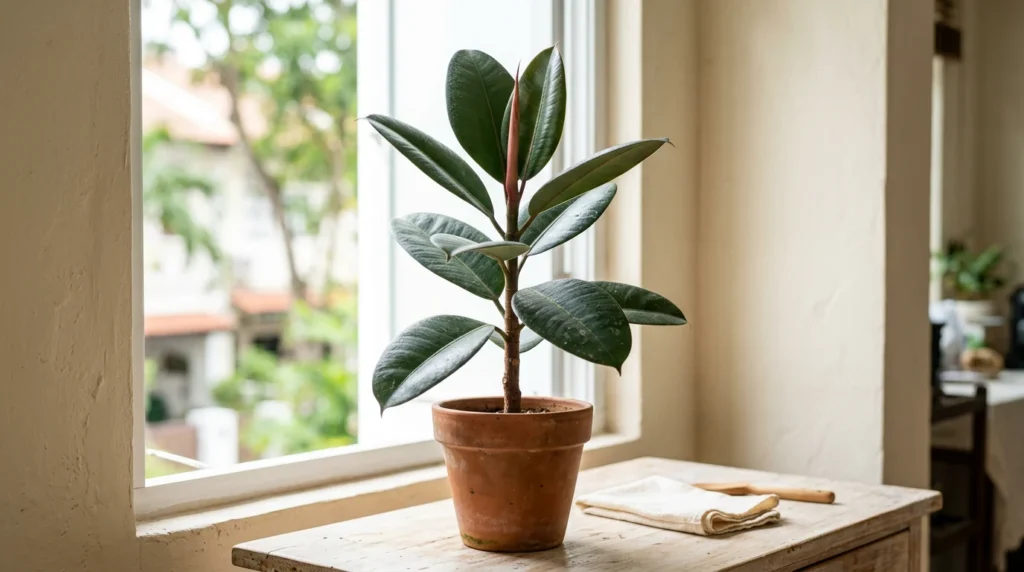
AI-generated plant image for this guide. Actual plants and growing conditions vary.
At a glance
• Check whether leaf loss followed a move, wet roots or a cold draft.
• One ageing lower leaf is different from rapid loss across the plant.
• Clean dusty leaves gently and inspect their undersides while you do it.
Rubber plant care: how much light does it need?
Choose a bright position with filtered light. A plant can look attractive in a shaded corner while receiving too little light for strong growth. Variegated leaves naturally contain pale areas; those markings are not automatically disease or nutrient deficiency.
Avoid abruptly moving an indoor plant into strong afternoon sun. Increase exposure gradually and watch for dry pale patches on the sun-facing leaves. In a Singapore flat, a deep balcony overhang can substantially change the light at a window, so assess the plant's position rather than using the room's compass direction alone.
Keep it away from direct cold air-conditioner airflow. Stable conditions make changes easier to interpret. If you move it, note the date and photograph the foliage so you can compare the next leaves rather than relying on memory.
How should rubber plant care include watering?
Let the upper medium dry before watering again, while checking that the root ball is not remaining saturated below. Water through the root zone and let excess water drain. Empty the outer pot or saucer; hidden water can keep roots wet even when the visible surface seems dry. The right interval changes with pot size, root growth, medium and light. A large floor container can retain moisture at its centre for much longer than a small nursery pot. Use a clean skewer and pot-weight checks where possible, and do not assume every plant in the same room should be watered together.
If the plant has recently lost many leaves, it may use water more slowly. Continue checking the medium rather than giving extra water as reassurance. Persistently damp roots plus declining foliage warrant a root-health assessment.
Rubber plant care problems: why are the leaves dropping or turning yellow?
Review the pattern.
An occasional old lower leaf dropping can be normal, while rapid loss after a move may reflect stress. Wet medium, insufficient light, cold drafts and pests are among the possible causes. Record what changed instead of immediately combining fertiliser, repotting and several sprays.
Check the base, drainage holes and root zone before deciding the plant is thirsty. Yellowing does not identify one cause. A plant with impaired roots may wilt even in wet medium. If the pot is genuinely dry and roots appear sound, restore even watering and monitor the response.
Look at leaf undersides and stems for attached scale insects, cottony mealybugs or fine mite damage. Use the scale guide or mealybug guide when those signs match. Old marks will remain after the cause is corrected, so track whether new damage appears.
How do you clean or prune in rubber plant care?
Support each leaf underneath and wipe dust gently with a soft damp cloth. This is also a chance to inspect for insects. Avoid vigorous rubbing or treating shiny foliage as a reason to coat it with household oils or unlabelled mixtures.
Rubber plants release milky sap when cut. Wear gloves, protect nearby surfaces and keep sap away from eyes and mouths. Use a clean tool if pruning is necessary. A damaged leaf cannot be repaired by cutting the edge into a new shape; pruning should serve the plant's structure or remove unsuitable tissue.
Do not assume a detached leaf that makes roots will become a branching rubber plant. Propagation requires suitable stem material and a growing point. If you want to shape a large plant, plan the cut before removing substantial growth rather than repeatedly trimming in response to every blemish.
When does rubber plant care include repotting or fertilising?
Repot when roots crowd the container or the medium no longer drains and holds moisture appropriately. Use a draining pot with a modest size increase and preserve the original planting depth. Do not bury the stem or strip healthy roots bare unnecessarily. See the step-by-step repotting guide.
A free-draining all-round medium such as Potting Mix can suit a soil-grown rubber plant. Check its drying behaviour in your actual container. Feed a healthy established plant according to the product label, rather than feeding a newly stressed or waterlogged root system.
After changing one important condition, observe the next growth. Firm leaves, stable leaf retention and normal new foliage are useful signs. A recovery product cannot guarantee that lost leaves will return to the same bare section of stem.
Rubber plant care and placement
Rubber plant care rewards a stable position. Ficus elastica dislikes frequent moves, and leaf drop often follows a change in light, temperature or watering.
Bright indirect light supports sturdy growth and good leaf colour, and variegated forms may need slightly more light to hold their colouring. Adjust rubber plant care gradually when you move the plant.
Keep the plant away from direct air-conditioner draughts and from heavy shade, and give the leaves room. Stable conditions make rubber plant care much simpler.
Rubber plant care: leaves, pruning and sap
Wipe the large leaves occasionally so dust does not block light, which is useful rubber plant care. Check leaf undersides while you wipe.
Pruning can encourage branching in an unbranched rubber plant, but the plant produces a milky sap that can irritate skin and stain surfaces, so protect your hands and work area. This is general rubber plant care advice; handle the plant with care.
Prune with clean tools just above a node, and give the plant time to respond before pruning again.
Rubber plant care for repotting and feeding
Repot when roots fill the container or growth stalls despite good light. Rubber plant care after repotting means steady light and watering based on the medium.
Feed lightly during active growth, following the product label. Rubber plant care does not need heavy feeding.
See our repotting guide and the soil and garden mixes category for rubber plant care supplies.
Rubber plant care and common pests
Rubber plant care includes occasional pest checks, because the broad leaves can host spider mites, scale insects and mealybugs.
Look at leaf undersides and the junctions where leaves meet the stem when you wipe the leaves.
If you find insects, isolate the plant and see our houseplant pests guide for identification before treating.
Rubber plant care that keeps the plant healthy and stable makes pest problems easier to manage.
Rubber plant care and pot choice
A tall rubber plant benefits from a heavy, stable pot with drainage holes, which helps rubber plant care by reducing the risk of tipping.
Choose a container that fits the root ball. A much larger pot keeps the medium wet for longer and works against rubber plant care.
Empty any saucer after watering so the roots do not sit in water.
Repot into a slightly larger pot only when roots fill the container or growth stalls despite good light.
Products to consider
Potting Mix is an option for a necessary repot. GROW can support routine feeding once the plant is stable and growing. Diagnose sudden leaf drop before buying a recovery or pest product.
Common questions
Is the red sheath on a new leaf a problem?
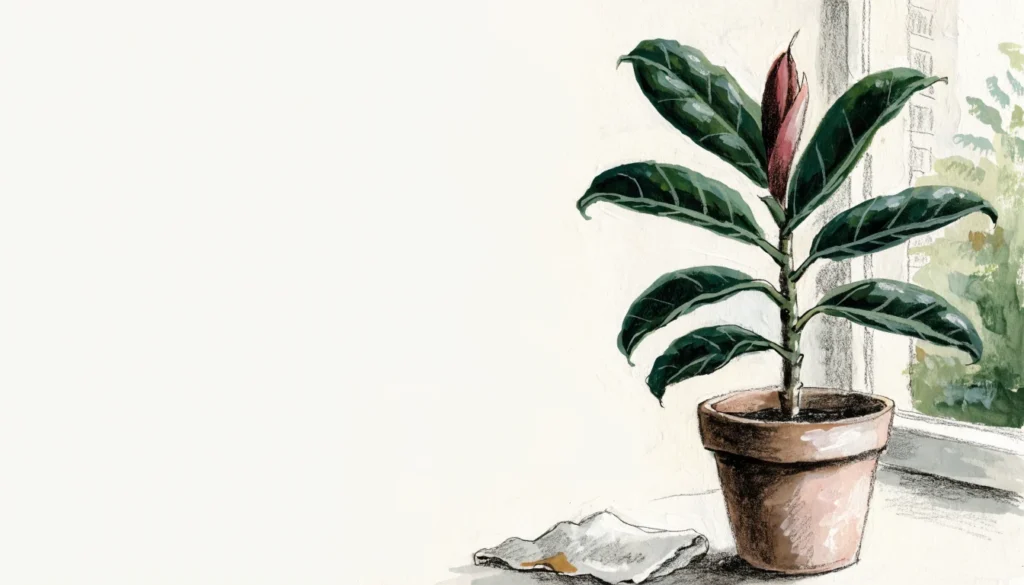
Rubber plants commonly produce a protective sheath around developing foliage. It is different from a new spreading lesion on an established leaf. Watch the leaf emerge normally and avoid pulling the sheath apart to speed up the process.
Should every fallen leaf trigger repotting?
No. Check the pattern and growing conditions first. Repotting adds disturbance and is useful when roots, container size or the medium justify it. An isolated ageing leaf does not by itself show that the plant needs a new pot.
Can I use leaf-shine products?
Simple gentle cleaning with water and a soft cloth is usually sufficient for dust. Avoid improvised oils or cleaning mixtures. If considering a commercial product, check that its label permits use on the plant and follow its directions.
Why is my rubber plant dropping leaves?
Review recent changes in light, position and watering first. The guide above covers common causes, and rubber plant care should stay steady while you investigate.
How often should rubber plant care include watering?
Check the medium instead of following a fixed schedule, and water when the top has started to dry while allowing excess water to drain.
Can rubber plant care include moving it outdoors?
A move changes light and wind quickly, so introduce any change gradually. Rubber plant care favours a stable position over frequent moves.
Quick answers about rubber plants
Why is my rubber plant dropping leaves? Sudden changes in light, watering or position are common triggers. Review recent changes before adding products.
Can I make my rubber plant bushier? Pruning above a node can encourage branching, but wear gloves because the sap can irritate skin.
Should I wipe rubber plant leaves? Yes, a damp cloth removes dust so the leaves can use light, and it lets you check for pests.
How big does a rubber plant grow indoors? It can become tall over time, so plan for the space and prune if it outgrows its position.
Read next
How to repot plants: a practical Singapore home guide
Scale insects on plants: separate live pests from harmless bumps
Sources and further reading
NC State and RHS describe light, drainage and stable conditions as foundations for Ficus care. Editorial method: this guide draws on the horticultural references below and adapts their care principles to Singapore homes. It does not report a Sprout Lab product trial. Product suggestions are optional and should follow their labels. Learn about Sprout Lab or contact us with photos and growing conditions for help choosing a next step.
NC State Extension: Ficus elastica — accessed 10 October 2026.
RHS: Ornamental figs growing guide — accessed 10 October 2026.
Prepared by the Sprout Lab editorial team using the horticultural references above. Local examples adapt general guidance to Singapore homes; they are not results of product trials. Product suggestions use current Sprout Lab descriptions. Follow the label for application instructions.