Bird of paradise care starts with a bright position, room for the leaves and a draining root zone. Split leaves are not automatically a pest problem. Curling or drooping deserves a check of moisture, heat and roots. First identify whether you have Strelitzia reginae or the much larger Strelitzia nicolai often sold for indoor foliage.
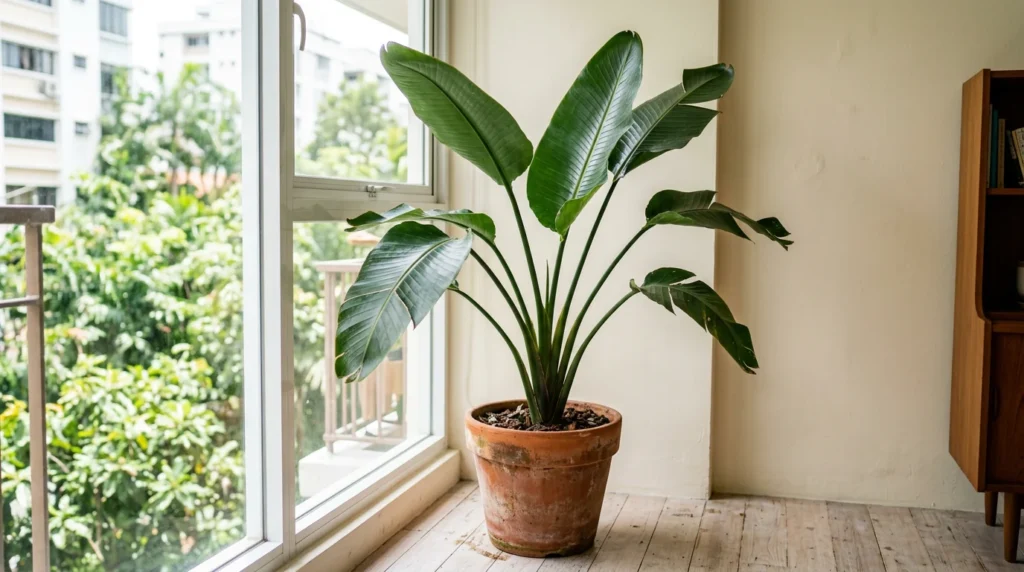
AI-generated plant image for this guide. Actual plants and growing conditions vary.
At a glance
• Plan for mature size; a large foliage plant needs more than a decorative corner.
• Natural leaf splits are different from expanding damaged patches.
• Check the centre of a large pot before watering again.
Bird of paradise care: which bird of paradise do you have?
Strelitzia reginae is associated with orange-and-blue flowers. Strelitzia nicolai has much larger leaves and can become a substantial plant. The compact plant you bring home will not necessarily stay suitable for the same narrow indoor space. Check the nursery label and leave space for new leaves to open. Do not position a tall pot where wind or passing traffic can tip it. On a Singapore balcony, consider both rain exposure and the force of gusts before choosing the most visually attractive corner.
How much light does bird of paradise care require?
Give it a genuinely bright location. A large window or suitable bright balcony is usually more promising than a deep indoor corner. Increase direct sun exposure gradually if the plant has been grown in shade; a sudden move can damage existing leaves.
Slow growth or weak, stretched growth can reflect inadequate light, though root and nutrient conditions also matter. Move the plant only after assessing the actual daylight reaching its leaves. If using artificial light, check that coverage is adequate for a large canopy; a small lamp aimed at one leaf cannot illuminate the whole plant evenly.
Do not judge an indoor foliage plant only by whether it flowers. Maturity and growing conditions influence flowering. Fertiliser cannot guarantee blooms in a position that does not meet the plant's light needs.
Bird of paradise care: why are the leaves splitting, curling or drooping?
Leaf blades can split along their side veins, particularly after wind or physical handling. A few clean splits on otherwise healthy leaves are not automatically disease. Avoid repeated spraying or pruning simply because the leaves no longer look like a shop photograph.
Curling or drooping can occur when water supply and water loss are out of balance. Check the medium, pot weight, recent heat exposure and any change in position. A dry root ball needs a different response from a heavy, wet pot with damaged roots.
Expanding brown patches, fine stippling or webbing deserve closer investigation. Examine the underside of leaves and nearby plants. Use our spider-mite guide if you see matching signs, and the leaf damage guide for sun-related patterns. A split leaf alone does not justify pesticide use.
How do you water a large container properly?
Check moisture below the surface before watering.
Large containers can look dry on top while holding a wet centre. When water is needed, apply it evenly through the root zone, let it escape through drainage holes and empty collected water.
Keep track of rain reaching the pot. A sunny balcony can dry quickly during one spell and remain wet during another. If the plant is in a decorative container, make sure you can access and empty it; a heavy plant makes hidden standing water easy to overlook.
If the medium stays wet and the plant declines, inspect drainage before feeding. Our compacted-soil guide explains why adding water or fertiliser does not fix a root zone with too little air.
When does bird of paradise care include repotting, feeding or leaf cleaning?
Repot when root crowding, instability or deteriorating medium makes it necessary. Use a sturdy container with drainage and a modest size increase. Large specimens are awkward to handle, so arrange help and support the root ball rather than pulling on the leaf stalks.
A free-draining all-round medium such as Potting Mix is an option for a soil-grown container plant. Check how it behaves in your pot and location. Feed healthy growth at the product's labelled rate, rather than treating slow growth in shade with an extra-strong dose.
Wipe dusty leaves gently with a damp cloth while supporting them underneath. Remove badly damaged leaves only as needed with clean tools. Photograph the next emerging leaf and watch whether it opens normally. That tells you more about progress than old splits, which remain visible.
Bird of paradise care and space
Bird of paradise care begins with space. Strelitzia nicolai can grow very large and wide, so check the room you have before choosing a plant, and give any bird of paradise room for its leaves to open without rubbing.
Leaves can split naturally as they age and in wind, which is common for this plant. Bird of paradise care does not need to stop splitting entirely; look instead for steady new growth.
Turn the pot occasionally so growth stays balanced toward the light, and keep the plant clear of air-conditioner draughts as part of bird of paradise care.
Bird of paradise care: watering and feeding
A large container holds a lot of medium, so bird of paradise care depends on checking moisture below the surface before watering. Water thoroughly and allow the excess to drain.
Feeding supports growth in an established plant. Follow the product label, and treat feeding as one part of bird of paradise care alongside light and drainage. The plant care range lists what Sprout Lab stocks.
Wipe dusty leaves with a damp cloth so the plant can use light efficiently, and use the moment to look for pests on leaf undersides.
Bird of paradise care for flowering and repotting
Indoor flowering is not guaranteed. Bird of paradise care that provides strong light, a mature plant and steady growth gives the best chance, but a plant may still not flower indoors.
Repot when roots crowd the container, choosing a heavy, stable pot with drainage because a tall bird of paradise can tip. Bird of paradise care after repotting means steady light and careful watering.
Our repotting guide covers the steps, and the soil mixes page compares media for bird of paradise care.
Bird of paradise care for pests and leaf cleaning
Bird of paradise care includes checking the large leaves for pests. Look at the undersides and along the midrib for insects or webbing.
Wipe leaves gently, supporting each leaf with your hand so the blade does not tear. Gentle cleaning is part of bird of paradise care and lets you inspect the plant at the same time.
If you find pests, read our houseplant pests guide. Bird of paradise care for pests starts with identification.
Keep the plant out of strong draughts, since wind can speed up leaf splitting.
Bird of paradise care and pot choice
A tall bird of paradise needs a heavy, stable pot with drainage holes, so choose a container that will not tip when the plant grows.
Bird of paradise care also means allowing room for the roots. Repot when roots crowd the pot, and choose a size that fits rather than a very large container.
Water thoroughly and let excess drain, and avoid leaving the pot standing in a saucer of water.
Keep the weight in mind when you plan to move the plant, and ask for help lifting a large container.
Products to consider
Potting Mix is an option when a soil-grown bird of paradise needs repotting. GROW can support routine feeding after establishment; address poor light, trapped water or pest damage first.
Common questions
Are torn leaves a sign the plant is dying?
Not by themselves. Natural splitting and mechanical damage are common on large leaf blades. Check whether the plant is still producing healthy leaves and whether there are other symptoms, such as soft roots, spreading lesions or visible pests.
Can it live far from a window?
A dim position is unlikely to support strong growth. Assess the daylight reaching the whole canopy, not just the room's appearance. If there is no suitable bright space, changing the plant's location or choice may be more useful than adding fertiliser.
Will BLOOM make it flower indoors?
No product can guarantee that. Flowering depends on the species, maturity and growing conditions, including light. Establish healthy foliage and roots first, and follow any product label rather than increasing the dose to chase flowers.
What is the simplest bird of paradise care routine?
Bright light, a pot with drainage, thorough watering once the medium has started to dry and room for the leaves. That covers the basics of bird of paradise care.
How big will a bird of paradise get indoors?
It depends on the species and the space. Strelitzia nicolai can become very large, so plan bird of paradise care around the room available.
Can bird of paradise care include pruning?
You can remove fully dead or damaged leaves at the base with clean tools. Bird of paradise care does not need heavy pruning, and removing healthy leaves reduces the plant’s ability to grow.
Quick answers about bird of paradise plants
Why are my bird of paradise leaves splitting? Leaves split naturally with age and wind, and heavy splitting can also follow dry spells. Look for steady new growth rather than perfect leaves.
How much light does a bird of paradise need? Bright light, ideally with some direct morning sun, suits it best. Introduce stronger sun gradually.
Can a bird of paradise live indoors? Yes, with strong light and space, though flowering indoors is uncommon. Choose a position with a bright window.
How often should I fertilise? Lightly during active growth, following the label. Fertiliser cannot replace light.
Read next
How to repot plants: a practical Singapore home guide
Spider mites on indoor plants: identify the cause before spraying
Sources and further reading
RHS distinguishes the two common Strelitzia species, while NC State notes wind-related leaf tearing. Editorial method: this guide draws on the horticultural references below and adapts their care principles to Singapore homes. It does not report a Sprout Lab product trial. Product suggestions are optional and should follow their labels. Learn about Sprout Lab or contact us with photos and growing conditions for help choosing a next step.
RHS: Strelitzia growing guide — accessed 10 October 2026.
NC State Extension: White bird of paradise — accessed 10 October 2026.
Prepared by the Sprout Lab editorial team using the horticultural references above. Local examples adapt general guidance to Singapore homes; they are not results of product trials. Product suggestions use current Sprout Lab descriptions. Follow the label for application instructions.