White marks on leaves are a description, not a diagnosis. Powdery mildew, dried spray residue, mineral deposits and mealybugs can all appear pale in a photograph, yet they call for different action. University of Minnesota Extension describes powdery mildew as white or grey surface growth, while University of Maryland Extension documents white crystallised mineral and fertiliser deposits. Start by inspecting the pattern and recent care history. A bottle labelled for insects should not be assumed to treat a fungal disease, and wiping a mark away does not by itself prove what caused it. Use the pest overview alongside this guide when you see actual insects.
On this page
What does powdery mildew usually look like?
How do mineral deposits and spray residue differ?
Could the white material actually be a pest?
What should you do while the diagnosis is uncertain?
How do humidity and airflow affect your next decision?
When is a treatment product appropriate?
What does powdery mildew usually look like?
Powdery mildew often appears as irregular pale surface patches rather than a neat ring where a droplet dried. University of Minnesota Extension describes white-to-grey powdery growth on leaves, stems and buds. The appearance can vary with the host and stage, so examine the whole plant instead of identifying a disease from colour alone.
Look at both sides of several leaves and compare new marks with older ones. Note whether patches are increasing and whether nearby leaves develop similar symptoms. Photographs taken under consistent light help because glare and dust can exaggerate pale areas. Include a close view and a whole-plant view when asking for identification.
Do not rub every affected leaf before documenting it. A gentle check on a small area can supply information, but surface growth and residue may both transfer to a cloth. The pattern, progression, plant identity and care history are more informative together than a single wipe test.
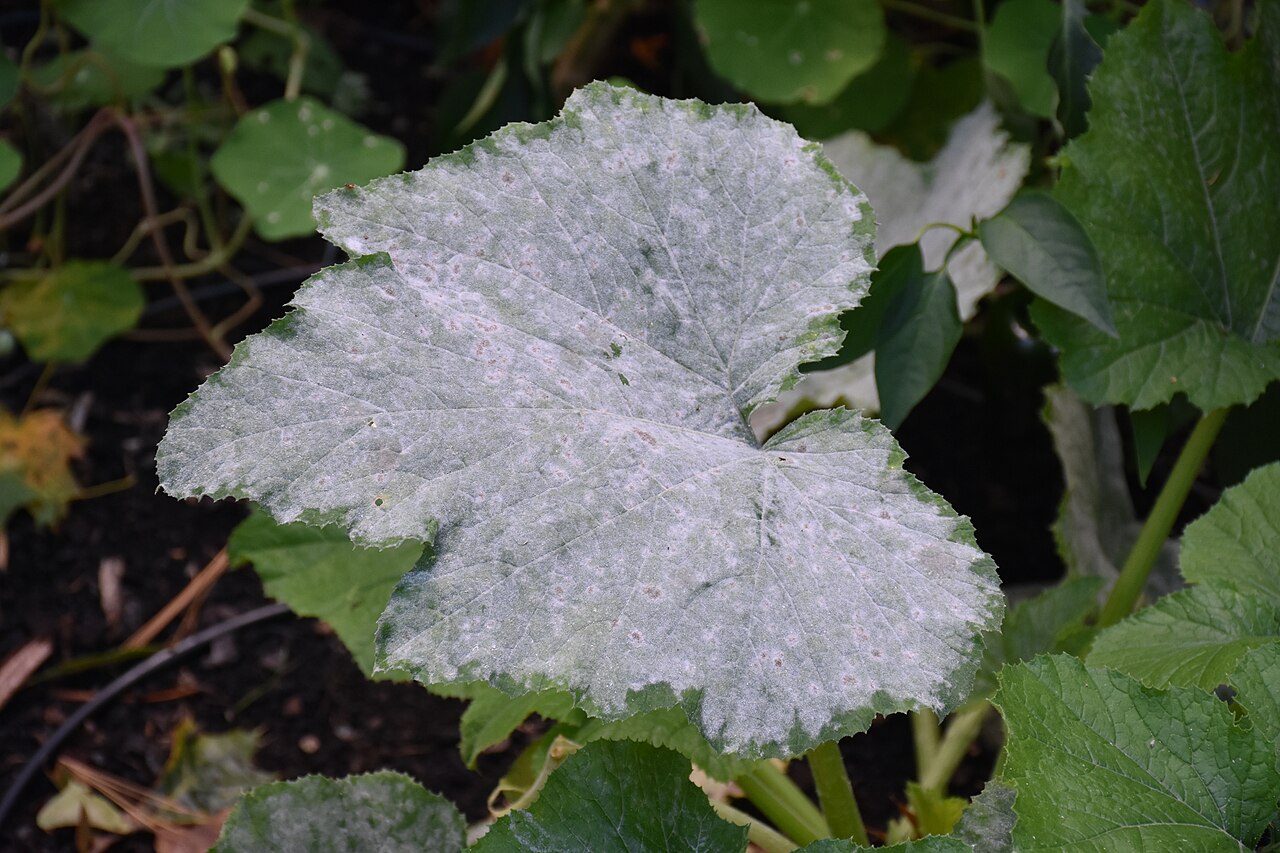
Real powdery mildew reference photo. Photo: Dmitry Brant, CC BY-SA 4.0, via Wikimedia Commons.
How do mineral deposits and spray residue differ?
Mineral or fertiliser residue may follow the outlines of dried droplets, splashes or runoff. University of Maryland Extension notes that mineral and fertiliser salts can form white coatings on leaves and crusts on the medium or pot. Check whether marks appeared after foliar feeding, misting, cleaning or a new spray product.
Compare leaves that received the application with sheltered leaves that did not. If the marks match the spray pattern and remain unchanged, residue becomes a useful possibility. That is still not proof. A plant can have residue and a separate pest or disease problem, so inspect for living organisms and tissue damage too.
Avoid applying household acids, detergents or polish to remove an unknown white coating. Delicate leaves can be injured by an improvised cleaner. Where gentle cleaning is appropriate for the species, use a small test area and clean materials. Prevent recurrence by following product application instructions and wiping accidental spills rather than repeatedly layering sprays.
Could the white material actually be a pest?
Cotton-like material concentrated in leaf joints, stem crevices or around insects suggests a different route from a diffuse powdery leaf coating. Mealybugs produce waxy material and can hide in protected spaces. Inspect with magnification and look for the organism itself rather than assuming every fluffy patch is fungal growth.
Sticky residue and ants may provide additional clues, but they do not establish which insect is present. Look beneath leaves, along stems and around new growth. If living pests are found, use the appropriate pest-specific guide and treatment label. A disease-focused response can miss an active insect infestation entirely.
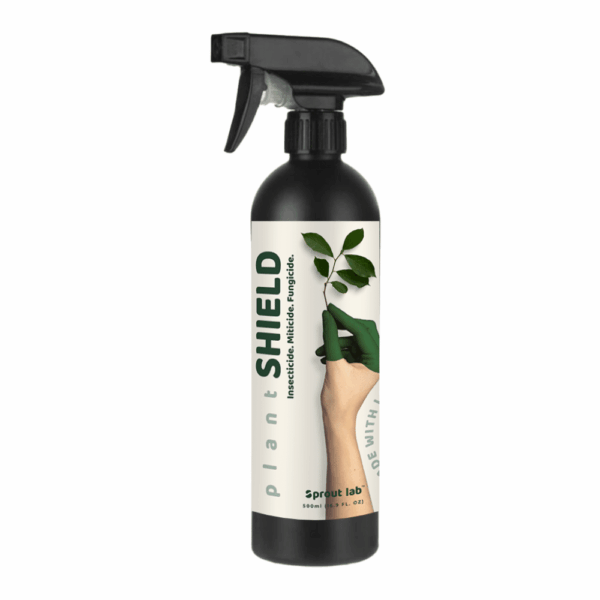
Plant SHIELD is only a product to consider after matching the actual pest, host and application site with its current label. Its catalogue name is not proof of effectiveness against every white mark or every fungus. For edible plants, verify crop and harvest permissions separately.
What should you do while the diagnosis is uncertain?
Separate the affected plant enough to inspect it without leaves touching neighbouring plants. Avoid moving contaminated tools or cloths through the collection. Pause unnecessary foliar products so new marks are easier to interpret. Continue appropriate root-zone care; uncertainty about a leaf coating does not mean the plant should be left dry or flooded.
Record the plant's name, location, recent sprays, watering method and when marks first appeared. This simple evidence sheet is an original diagnostic aid. It helps distinguish a changing biological problem from a static residue event and gives an adviser a clearer history than a single photograph without context.
Do not begin several treatments simultaneously. If you change cleaning method, spray a pesticide and relocate the plant on the same day, later damage becomes harder to explain. Take the least disruptive useful step first, such as isolating, documenting and checking the label of the last product used.
How do humidity and airflow affect your next decision?
Avoid assuming that all fungal diseases require visibly wet leaves. University of Minnesota Extension explains that powdery mildew differs from many leaf-spot fungi because it does not need rain or dew on the leaf to infect. Therefore, simply stopping misting is not a complete diagnosis or a guaranteed control method.
Improve practical spacing so leaves can be inspected and air can move between plants. A crowded shelf behind a curtain may create a different environment from the room around it. Keep a fan arrangement gentle and appropriate rather than directing a strong drying blast at a weakened plant. Address crowding without abruptly changing every environmental condition.
In a Singapore flat, compare a sheltered balcony cluster, an air-conditioned room and a humid enclosed cabinet separately. Do not apply advice from one location mechanically to another. Check whether the plant actually suits the conditions available. Environmental adjustments support management but do not establish whether a coating is mildew, residue or insect wax.
When is a treatment product appropriate?
Use a disease treatment only after identification and confirmation that its current label covers the disease, plant and use location. A product sold as natural, organic or multipurpose does not remove those checks. This guide does not provide homemade fungicide recipes or assume that an insect-control product has verified mildew-control permission.
A recovery product such as Plant HEAL should be treated as optional label-directed support. It is not presented here as a proven cure for powdery mildew, mineral deposits or mealybugs. Correct diagnosis and the relevant management measures come first; purchasing a supportive product is not required to begin those steps.
For herbs and vegetables, edible-crop restrictions are particularly important. Check the exact crop, rate, application interval and harvest instructions before use. Do not infer food-crop suitability from the word plant or from a product being suitable for ornamental foliage. Ask for the label if the product page does not provide enough information.
What should you avoid doing to affected foliage?
Do not scrub fragile leaves aggressively or remove most of the canopy to eliminate a cosmetic mark. First decide whether the tissue is alive and whether the problem is spreading. Some plants tolerate leaf cleaning poorly, while others have natural surface coatings that should not be rubbed away merely because they look pale.
Avoid stacking oils, soaps, fertilisers and recovery sprays without checking compatibility. Leaf injury from treatment can resemble worsening disease. University of Maryland Extension cautions that heavily pest-damaged plants can also be injured by sprays. Follow label restrictions, test appropriately when directed and avoid application conditions that the label excludes.
Do not use a visible improvement immediately after wiping as proof of eradication. A clean-looking leaf may still need observation. Conversely, a harmless stain remaining on old tissue does not prove ongoing infection. Track new marks and new growth rather than repeatedly treating the same old cosmetic damage.
How do you know whether the response is working?
Compare documented leaves and inspect new growth. If fresh white patches appear, revisit the diagnosis and treatment fit. If the same static marks remain after a known spray event but no new symptoms develop, residue may be a more useful explanation. Seek expert identification if changes are rapid or the plant's condition declines.
Keep the plant separate while an active pest or disease problem is unresolved. The time needed depends on the organism and treatment, so there is no universal declaration of safety after one clean inspection. Continue normal appropriate watering and avoid forcing new growth with heavy feeding during uncertainty.
Use the leaf-spot versus sun-damage guide if the white mark becomes dead brown tissue, and the post-pest recovery guide after a confirmed infestation is controlled. The next product decision should follow the remaining problem, rather than continuing every product used during the investigation.
Powdery mildew: how to confirm what you see
Powdery mildew looks like a white or grey dusting on the leaf surface that can sometimes be wiped off, but wiping does not prove it is not powdery mildew. Check both sides of the leaf, new growth and stems, because powdery mildew often appears on shaded, crowded foliage.
Mineral residue from water or sprays usually forms a hard, crusty deposit and stays in place, while powdery mildew tends to spread across the leaf over days. Photograph the leaf now and again in two or three days to see whether powdery mildew is spreading.
Powdery mildew can be mistaken for mealybugs, which are cottony and mobile. If you see small insects as well as a white coating, treat the two problems separately and see our mealybug guide.
Reducing powdery mildew risk
Reducing powdery mildew risk is mostly about airflow, light and spacing. Give plants room, avoid crowding foliage together and remove badly affected leaves, bagging them rather than composting so that powdery mildew spores are not spread.
Powdery mildew often shows up in still air and shaded positions, so moving a plant to a brighter, better-ventilated spot can help. Watch new growth for powdery mildew over the following weeks.
If powdery mildew keeps returning, compare a labelled product for your plant type and follow its directions, noting any edible-crop restrictions. A product does not replace better airflow, and persistent powdery mildew deserves a closer look at conditions.
Products to consider
SHIELD is conditional on a confirmed label-covered insect lookalike, not assumed mildew control. HEAL is optional supportive care only. No purchase is necessary for harmless residue, and unverified fungicidal or edible-crop claims are excluded.
Common questions
If white marks wipe off, does that mean they are harmless?
No. Residue and some surface growth can both transfer to a cloth. Look at the pattern, progression, plant identity and recent spray history. Check for insects and new symptoms too. A wipe test is one observation, not a complete diagnosis or confirmation that a disease has been eliminated.
Can Plant SHIELD treat powdery mildew?
Do not assume that from the catalogue name alone. Verify the current label for the exact disease, plant and application site before considering it. This guide links SHIELD for confirmed label-covered insect pests, not as an unverified universal fungicide. Edible crops need separate label permission.
Should I repot a plant with white leaf marks?
Not automatically. A surface leaf problem does not prove that the growing medium needs replacement. Repot only when roots, drainage or medium condition provide a separate reason. Unnecessary root disturbance can add stress while leaving the actual leaf problem unchanged.